

Blood of the Scots History Meaning and Scottish Identity

“Blood of the Scots” sounds ancient, as if it came straight from a battlefield cry or a bard’s song beside a Highland fire. The phrase carries weight because it points to something larger than ancestry alone. It suggests kinship, memory, sacrifice, pride, and a stubborn sense of belonging that survived war, union, exile, and reinvention.
Yet the phrase is not a single formal motto with one clear birth date. It is better understood as a cultural idea. Over centuries, Scots have used blood as a symbol for family, clan, loyalty, land, and shared struggle. Sometimes that symbolism inspired resistance. Sometimes it hardened into exclusion. At its best, it describes a living bond with Scotland’s past, one grounded not only in descent, but also in language, place, story, and choice.

The phrase grew from kinship, clan, and contested kingdoms
The idea behind “Blood of the Scots” begins with medieval and early modern Scotland, where kinship shaped politics, law, and survival. In Gaelic-speaking regions, especially in the Highlands and Islands, identity often centered on the clan, a word related to children or descendants. A clan was more than a surname group. It could include blood relatives, adopted members, tenants, allies, and dependents who owed loyalty to a chief.
Blood mattered, but it was not always as simple as genetics. A person could belong through service, marriage, fostering, shared land, or mutual protection. That created a flexible but powerful sense of “us.” It also produced fierce rivalries. Clan feuds, raids, and alliances became part of the social order, especially where royal authority was distant or uneven.
In the Lowlands, identity formed through different structures: burghs, noble houses, church institutions, and royal law. Still, family lines and loyalty mattered there as much as in the Highlands. Names such as Bruce, Stewart, Douglas, Campbell, MacDonald, and Gordon became tied to power, land, and political memory.
The idea of Scottish blood also grew from the making of Scotland itself. The medieval kingdom emerged from a mix of peoples, including Gaels, Picts, Britons, Angles, Norse settlers, and later Norman-French families. That mixed origin matters. Scottish identity never came from one pure line. It came from the blending of peoples under a kingdom, a crown, and eventually a national story.
So when people speak of the “blood of the Scots,” they often imagine a long ancestral chain. The historical reality is richer. Scotland’s bloodlines were never still. They crossed seas, borders, languages, and faiths.
War gave the phrase its emotional force
If kinship gave the phrase its roots, war gave it its fire.
The Wars of Scottish Independence in the late 13th and early 14th centuries turned loyalty to Scotland into a matter of life, land, and survival. After the death of Alexander III in 1286 and the later crisis over succession, Edward I of England sought influence over Scotland. Resistance followed, and two names became central to the memory of Scottish defiance: William Wallace and Robert the Bruce.
Wallace, a lesser noble, rose as a resistance leader and helped win the Battle of Stirling Bridge in 1297. His later defeat, capture, and execution in 1305 turned him into a martyr figure. Over the centuries, legend often enlarged Wallace beyond the record, but his symbolic role remained clear. He came to represent sacrifice for the realm.
Robert the Bruce’s story is more politically complex. He seized the Scottish throne in 1306 after killing John Comyn, a rival claimant, in Dumfries. Then he fought a long and uncertain campaign to secure his kingship and Scotland’s independence. His victory at Bannockburn in 1314 became one of the defining events in Scottish historical memory.
Bannockburn matters because it was not just a military success. It offered a lasting image of a smaller kingdom resisting a larger power. In later retellings, it became proof that Scottish freedom had been paid for in blood.

The Declaration of Arbroath, sent to Pope John XXII in 1320, gave this struggle a political voice. It argued that Scotland was an ancient kingdom and that its people would defend their liberty. One of its most famous ideas is that the king served the community of the realm, not the other way around.
That point reaches the heart of “Blood of the Scots.” The phrase is not only about who someone descends from. It also points to what people were willing to defend together.
Scottish identity was shaped by language, faith, and memory
The emotional power of Scottish blood does not come only from battle. It also comes from culture.
Scotland has never had one single cultural identity. Gaelic, Scots, Scottish English, Norse influence, and regional traditions all shaped the country. A person from the Hebrides, a fisherman from the northeast coast, a Border reiver, and a merchant in Edinburgh might all be Scottish, but their daily lives could differ sharply.
Language played a central role. Gaelic traditions preserved heroic tales, clan genealogies, praise poetry, laments, and songs tied to place. In the Lowlands, Scots became a language of court, law, poetry, and daily speech. Later, Scottish English grew as political and educational systems changed.
Faith also shaped identity. The Protestant Reformation in 16th-century Scotland transformed religious life and political power. Figures such as John Knox helped build a Presbyterian culture that stressed scripture, discipline, education, and resistance to perceived tyranny. This religious identity became deeply tied to Scottish political life, especially through the Covenanters of the 17th century.
The National Covenant of 1638 and the later conflicts involving Charles I, Charles II, and James VII and II showed how religious conviction could become national resistance. Many Covenanters saw themselves as defending a sacred Scottish way of worship against royal interference. Their suffering added another layer to the idea of blood, one tied not to clan descent, but to conscience.
Then came the Union of the Crowns in 1603, when James VI of Scotland also became James I of England, and the Acts of Union in 1707, which joined Scotland and England into Great Britain. Union did not erase Scottish identity. It changed the terms of it. Scots became part of a larger British state while continuing to preserve separate systems of law, education, and church life.
That tension still echoes. Scottish identity has often lived between attachment and resistance, between participation in Britain and insistence on Scotland’s distinct voice.
Figures who embody the blood of the Scots
Certain historical figures stand out because their lives show how Scottish identity has been argued, defended, mourned, and remade.
William Wallace remains the most famous symbol of resistance. His historical life is less fully documented than his legend, yet his meaning is clear. He represents the cost of defiance.
Robert the Bruce embodies political survival. His path to power was ruthless, but his success gave Scotland a king who could claim independence on the battlefield and in diplomacy.
Isabella MacDuff, Countess of Buchan, deserves more attention. She crowned Robert the Bruce at Scone in 1306, acting in a ceremonial role linked to her family’s hereditary rights. The English later punished her harshly. Her story shows that women were not passive observers in Scotland’s political struggles.
James Douglas, known as the Black Douglas, became one of Bruce’s closest commanders. His raids and military skill made him a feared figure in the independence wars. His later mission to carry Bruce’s heart toward the Holy Land added a striking symbol to Scottish memory, even though the campaign ended in Spain.
Mary, Queen of Scots represents another side of Scottish identity: dynasty, religion, gender, and tragedy. Her life linked Scotland to France, England, and Catholic Europe. Her forced abdication in 1567 and execution in 1587 made her one of the most debated figures in Scottish history.
Flora MacDonald became famous for helping Charles Edward Stuart, known as Bonnie Prince Charlie, escape after the failed Jacobite rising of 1745. Her act fed a romantic memory of Highland loyalty, even though Jacobitism itself was politically and socially complex.
Robert Burns, the poet, gave Scottish identity a democratic voice. He wrote in Scots and English, celebrated ordinary life, questioned rank, and helped preserve songs and speech that might have been dismissed as provincial. Burns shows that the “blood” of a people can flow through words as well as wars.
Culloden, the Clearances, and the memory of loss
No discussion of Scottish blood can ignore the 18th and 19th centuries. These years reshaped the Highlands and changed how Scottish identity was remembered.
The Jacobite rising of 1745 aimed to restore the Stuart line to the British throne. It drew support from some Highland clans, some Lowland Scots, English Jacobites, Irish interests, and European powers. It also faced opposition from many Scots. The conflict was not simply Scotland against England, despite later romantic versions.
The rising ended at the Battle of Culloden on April 16, 1746, near Inverness. Government forces defeated the Jacobite army in a short, devastating battle. The aftermath brought executions, repression, and laws meant to weaken Highland military culture. The wearing of Highland dress was restricted for a time, and the power of clan chiefs changed under pressure from the state.
Culloden became a wound in cultural memory. It stood for lost causes, broken loyalties, and the end of an older Highland world.
Then came the Highland Clearances, a long period of eviction, migration, and social upheaval. Landowners shifted estates toward sheep farming, sporting use, or new economic models. Many tenants were removed from inland settlements and pushed to coastal crofts, cities, or overseas destinations. Some left voluntarily under pressure of poverty. Others were forced out.
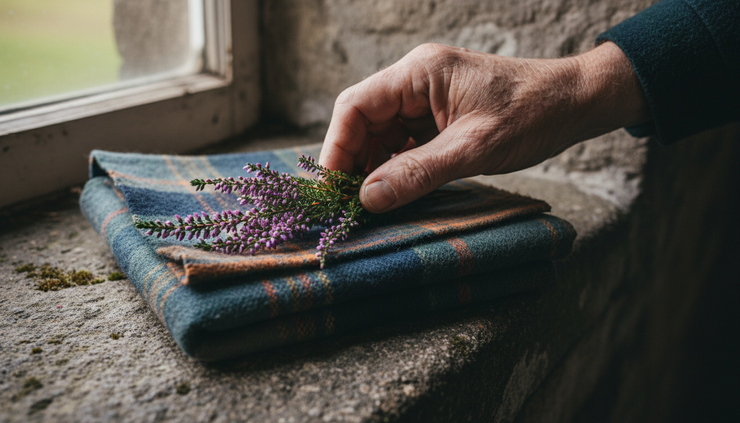
The Clearances gave “Blood of the Scots” another meaning: separation from homeland. In the diaspora, Scottish identity often grew stronger because distance made memory precious. Family names, tartans, songs, recipes, church records, and stories of departure became anchors.

Why the idea still matters today
Today, “Blood of the Scots” lives in genealogy searches, Highland games, clan societies, literature, music, political debates, and personal identity. It appears when someone learns the story behind a surname. It appears when a pipe tune brings unexpected emotion. It appears when people visit a battlefield, a family village, or an archive and feel history become personal.
At the same time, modern Scotland is not a museum piece. It is a living country with cities, islands, farms, universities, artists, old languages, and ongoing debates about sovereignty and belonging. Scottish identity today includes Gaelic revival efforts, Scots language advocacy, and renewed interest in local history.
The most useful meaning of “Blood of the Scots” is not narrow ancestry. It is connection with accountability. It asks people to remember the courage of Wallace and Bruce without turning them into cartoons. It asks people to honor Highland culture without reducing it to tartan and myth. It asks people to grieve Culloden and the Clearances while also recognizing the complexity of those events.
Scottish identity has always been made from both inheritance and action. Blood may begin the story, but it does not finish it. What keeps the story alive is the choice to learn, preserve, question, and pass it on with care.
The blood of the Scots, in the deepest sense, is a call to memory. It carries the weight of kinship, the cost of freedom, the sorrow of exile, and the ongoing work of belonging.


Comments